01DxSxT Network
Play is just the beginning.
Many games. One ecosystem. A world worth coming back to.
01DxSxT Network
Many games. One ecosystem. A world worth coming back to.
02Games
Casual puzzle games you can pick up in seconds, with more on the way.
03Quests
Try games from our partners, reach the goal and collect Contracts.
04Community
Get updates, rewards and ecosystem news.
How DxSxT works
Discover a game. Play in seconds. Progress every day. Earn rewards. Come back for more.
Games
Casual puzzle games you can pick up in seconds, with more on the way.
Playable demo
Mix potions for four mysterious clients by candlelight. No download needed. You're playing in 30 seconds.
Quests
Try games from our partners, reach the goal and collect Contracts.
Pick a partner game from the Quest list and install it.
Reach the Quest goal, like finishing a level.
Get your Contracts once the mission is confirmed.
Day 1 Day 2 Day 3 Day 4 Day 5 Day 6 Day 7
×2main Contract · 8 hours
Contracts unlock rewards, events and community status. Full details at launch.
Genesis NFT
Twenty Genesis cards. Each carries one skill that works inside the DxSxT app.
#00001Longevity MonkSkill Time Warp
Whitepaper
The architecture, token model, governance and roadmap of DxSxT Network.
The English text governs. Any translation is provided for reference only.
Most people never enter Web3 because the first step asks too much of them: understand a wallet, hold a token, accept volatility — all before anything enjoyable happens. DxSxT starts from the other end. It starts with games people already want to play.
DxSxT Network is a game-led digital ecosystem. It operates a portfolio of casual mobile games, an advertising-funded reward layer that pays users for verified engagement, and a set of on-chain components that give long-term participants a durable stake in what they helped build.
Three layers, in the order they matter:
Games. A growing portfolio of casual titles — puzzle, sorting, merge, hidden-object and similar — designed to be understood in seconds and played in short sessions. Each game is built to stand on its own as entertainment. A DxSxT game should still be worth playing with every reward removed.
Rewards, funded by advertising. Players earn Contracts by completing Quests: reaching a milestone in a partner app, watching an optional rewarded video, or returning across consecutive days. Advertisers pay for verified engagement; part of that payment reaches the player as Contracts, and DxSxT retains the margin.
Ecosystem. Contracts connect gameplay to progression, events, community standing and digital collectibles such as DxSxT Genesis. The on-chain layer exists to make participation portable and ownership real, not to be the reason someone opens the app.
To turn mainstream mobile players into long-term ecosystem participants — by earning their attention with games worth playing, rewarding them from real revenue rather than speculation, and giving the ones who stay a genuine stake.
DxSxT is built in sequence, not all at once. Each phase has to work before the next one is worth attempting.
Now — Games. Build a portfolio of casual titles and an audience that returns for them.
Now — Rewards funded by advertising. Turn that attention into revenue, and share part of it back with players as Contracts.
Next — The Creator Platform. Open the ecosystem to creators, so that content and games are produced by the community as well as by DxSxT.
Next — Developer tools. A GameFi SDK allowing third-party developers to integrate DxSxT rewards into their own titles.
Next — DAO governance. Progressive transfer of decision-making to token holders, including the veDST weighting model described in the Tokenomics chapter.
Next — Cross-chain. DxSxT is deployed on Solana. Interoperability with other chains is planned, without a committed timeline.
Later — A DxSxT chain. The long-term intention is to operate a DxSxT chain of our own, with the Solana deployment as a starting point rather than the destination. This is a direction, not a schedule. It depends on the earlier phases succeeding at a scale that would justify it, and it will only be attempted if and when that becomes true.
The order is deliberate. A creator platform without an audience is an empty storefront; creators go where the players already are. Developer tools and community governance both assume something worth building on and worth governing. Games come first because they are what brings people in.
Items marked "Next" are plans, not commitments. Items marked "Later" are stated directions with no timeline attached. Both may change, be re-sequenced, or be dropped.
Because DAO governance is not yet operating, decisions that the Tokenomics and Governance chapters describe as subject to DAO approval — treasury allocation, community release schedules, the rate at which Contracts redeem for DST, and any change to the supply model — currently rest with the operator named below.
We state this plainly rather than leaving it implied. Until governance is live, "DAO determined" means determined by the operator, and the transfer of those powers is itself a future event, not a present condition.
The limits of what DxSxT does:
Anything not described in this document is not being built.
DxSxT Network is operated by De Stijl Technology Network International Company Limited. This document is published by that entity. References to "we", "us" and "the team" throughout this Whitepaper refer to it.
An ecosystem people return to because they enjoy participating in it — not because they are waiting for a payout.
This document ("Whitepaper") serves solely to provide technical, visionary, and token economic model information pertaining to the DxSxT Network project. It does not constitute investment advice, a fundraising solicitation, a guarantee, a promise, or a legal contract in any form. Please carefully read the following risk disclaimer and legal terms before participating:
Holding or using DST Tokens involves the following significant risks:
| Risk Type | Description |
|---|---|
| Price Volatility | DST Token is not a stablecoin; its price may fluctuate dramatically due to market supply and demand. |
| Regulatory Risk | Different countries have varying definitions of crypto assets, and policy changes may affect usage and trading. |
| Technical Risk | Protocol errors, smart contract vulnerabilities, or failure of third-party tools may lead to asset loss. |
| Hacker & Security | The system may be subject to hacker attacks, resulting in data leakage or asset theft. |
| Liquidity Risk | If there is a lack of trading counterparts, DST may experience insufficient liquidity. |
| Ecosystem Risk | Insufficient adoption of protocols or applications may lead to a decrease in token value and utility. |
Important Reminder: Investors should prudently assess their own risk tolerance and bear any financial losses independently.
Advertisers pay to reach engaged players. DxSxT earns that money by delivering genuine engagement, and passes part of it back to players as Contracts. Nothing in the reward layer depends on token appreciation, new user deposits, or future fundraising.
Rewarded advertising inside our games. A player chooses to watch a video in exchange for a benefit in the game. The advertiser pays for that view. This is standard mobile advertising, served through Google AdMob.
Quests — advertiser tasks. An advertiser wants players to try their app and keep using it. They pay for verified engagement: reaching a level, completing a tutorial, returning across several days. These tasks reach us through offerwall inventory supplied by our advertising partner — currently Unity LevelPlay — rather than being sourced by DxSxT directly. What a completed Quest gives the player is an accelerator, not a Contract; the section below explains the difference.
The important word is verified. Advertisers pay on confirmed outcomes, not on clicks or impressions alone, and rewards are released only after that confirmation. This is why a Quest reward is not instant.
A Contract is not handed out for completing a task. It is produced by playing.
Each player has a progress meter. The meter advances on actual play — level progress, valid rounds, registered input — and not on elapsed time. A game left open on an idle device advances nothing. When the meter reaches 100%, the player receives one Contract and the meter resets.
Rewarded video and Quests produce accelerators, which raise the rate at which the meter advances. An accelerator is not a Contract and not a currency. It cannot be redeemed, transferred, or held for value, and it does nothing outside the game. Its only effect is that a player who watches an ad or completes a Quest reaches the same Contract sooner, by playing.
Two things follow from this design, and both are deliberate.
What the advertiser buys is real. A reward tied to play rather than to a claim means the engagement sold to advertisers is engagement that happened.
Farming is expensive. The common attack on reward applications is to automate the rewarded action. Where progress requires play rather than elapsed time, an idle session, an emulator left running, or a script that does not actually play the game produces nothing. The detection controls are addressed in the security chapter and are not published.
Daily cap. However many DxSxT games a player plays, a player earns at most ten Contracts a day across all of them. Accelerators change how quickly that cap is reached, not the cap itself. The accelerator rate and duration, and how the meter is defined in each game, will be published separately.
Advertiser payment splits three ways:
The exact split varies by advertiser, country and campaign, and is set by market rates rather than by protocol.
Reward ecosystems fail in a predictable way. Rewards are funded from token issuance or from new participants; the cost of rewards rises with user growth; the only way to keep paying is to issue more or recruit more. That is not a sustainable business model.
DxSxT's reward layer is funded by advertising revenue, which scales with engaged users rather than against them. More players who genuinely play are worth more to advertisers, which funds larger rewards, which is affordable precisely because the revenue exists first.
DxSxT does not pay out more than advertising revenue supports. Reward rates move with advertising economics — eCPM, fill rate, advertiser demand by country — and may go down as well as up. We would rather state this limit than let anyone infer a guarantee that does not exist.
Advertising is the only revenue line operating today. The creator platform described in the previous chapter may introduce others in future. Nothing in this document should be read as assuming revenue that does not yet exist.
Contracts are redeemable for DST. How that works, and what bounds it, is set out in the Tokenomics chapter.
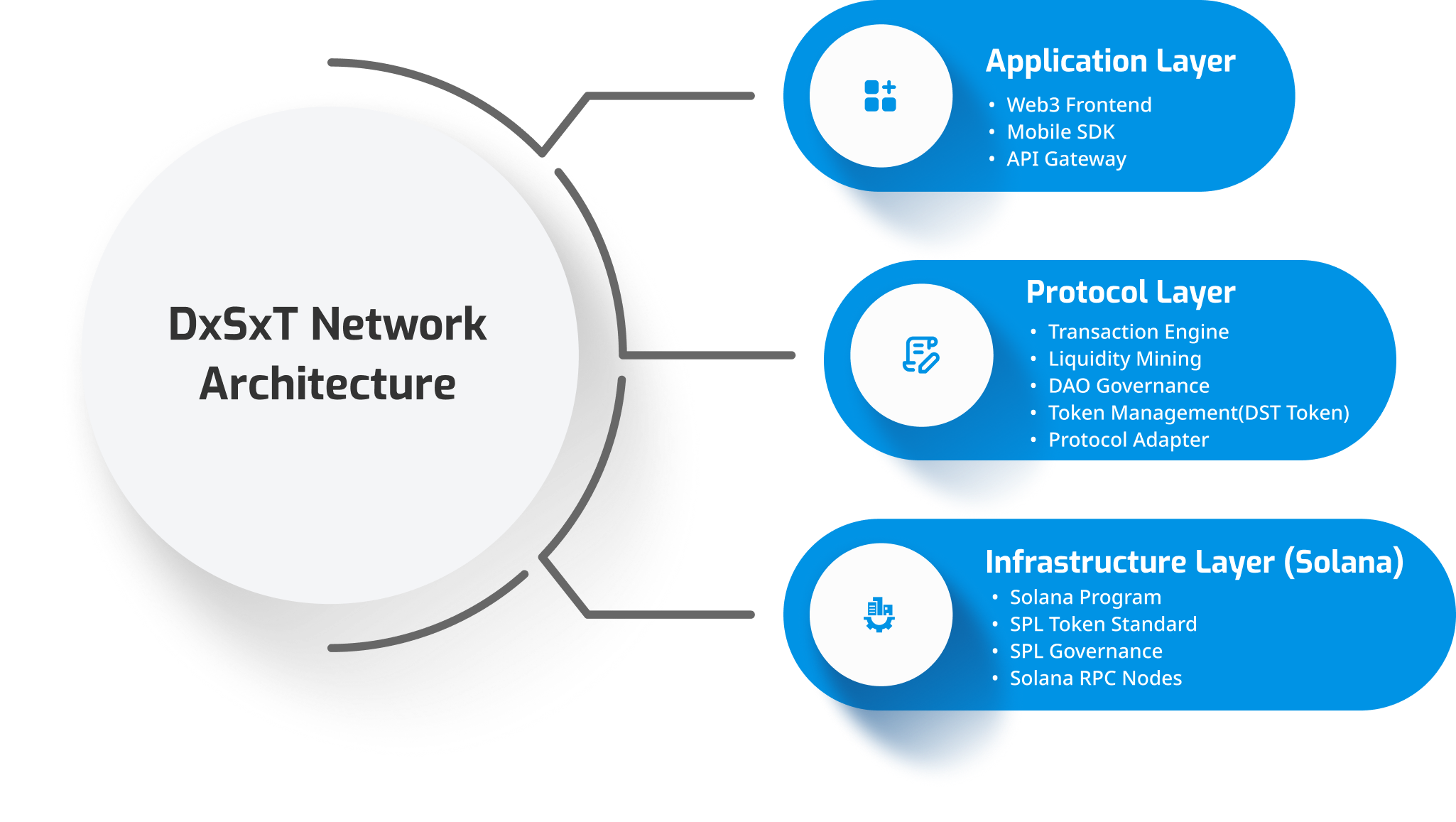
DxSxT Network is modular: protocol functions are deployed, upgraded and extended independently. The table below states what each module does and whether it is live today.
| Module | Function | Implementation | Status |
|---|---|---|---|
| DST Token Contract | Manages total supply, unlocking, distribution and user interaction, with built-in lock-up mechanisms. | SPL Token + custom economic model | Live |
| On-chain Transaction Engine | NFT issuance and transfer. Token conversion and asset exchange are not yet available. | Solana Program (Rust) + SPL Token | Partly live |
| Reward Distribution Module | Records completed Quests and allocates Contracts to users. Funded by advertising revenue, not by token issuance. | Completing a designated Quest earns its Quest reward | Live |
| Staking Module | Lock-up and staking as described in the Tokenomics chapter, including the veDST weighting model. | Smart contract + time-lock mechanism | Not yet active |
| DAO Governance Module | Community proposals, weighted voting, binding of contract execution. | SPL Governance + custom voting weight | Not yet active |
| Protocol Integration Module | Plug-in integration of third-party applications, including the GameFi SDK described in the opening chapter. | Standardised API + protocol adapter | Planned |
The transaction engine is marked "Partly live" because only part of what it is designed to do is in use: NFT issuance and transfer work today, and token conversion and asset exchange do not. A module is listed as live only for the functions actually running.
Modules marked "Not yet active" exist in the protocol design and are described in the Tokenomics and Governance chapters. They are not operating. Until they are, the decisions they would govern rest with the operator, as set out in the opening chapter.
| Module | Capability | Security design |
|---|---|---|
| Wallet connection | Connect and disconnect, network detection, account switching | Minimal permissions, domain binding prompts |
| Transaction sending | Single and batch, priority fees, retries | Replay protection, nonce management, standardised error codes |
| Asset management | SPL Token and NFT query and display | Read-only RPC, rate limiting, phishing contract flagging |
| Signing and verification | SIWS, message signing | Fixed message templates, risk prompts, expiry times |
Rewards in DxSxT are small and frequent. A user may earn Contracts several times in a single session. That pattern makes two properties decisive: the cost of settling a transaction, and the time it takes to settle. Solana was selected on those two grounds.
We do not reproduce network throughput figures here.
DxSxT's on-chain components are deployed on Solana. Solana was chosen for transaction cost and settlement speed, both of which matter when rewards are small and frequent.
Making DST and DxSxT assets usable on other chains is a planned direction, not a delivered feature. Any bridging would be implemented through established third-party protocols rather than built in-house.
We deliberately do not list target chains or named bridge providers in this document. Naming them before an integration exists creates the impression of a commitment that has not been made. Integrations will be announced when they are built, not before.
The long-term intention, stated in the opening chapter, is to operate a DxSxT chain of our own. The Solana deployment is the starting point rather than the destination.
This is a direction, not a schedule. Operating a chain is a substantially larger undertaking than operating an application, and it is only justified if the games, the reward economy and the ecosystem reach a scale that requires it. If that scale is not reached, it will not be pursued. We state this here so that it is not left unsaid later.
This chapter sets out what a third-party developer can build on DxSxT, which standards apply, and — the part these documents usually omit — what is available today.
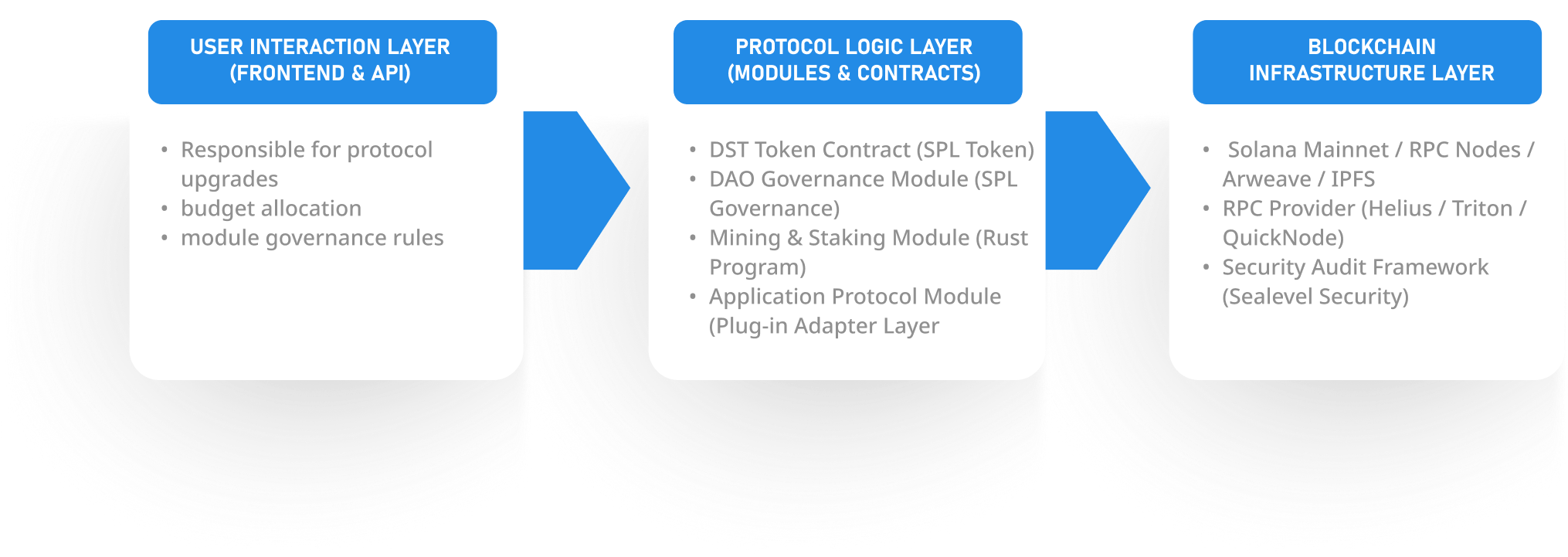
The contracts described in the previous chapter are deployed on Solana and can be read by anyone. What does not yet exist is a supported integration path.
| Capability | What it would let a developer do | Status |
|---|---|---|
| On-chain contracts | Read the token, transaction and reward contracts directly from Solana, as anyone can with any deployed program | Deployed |
| Plug-in SDK | Write an integration through a client library instead of against the chain by hand | Not yet released |
| GameFi SDK | Award DxSxT rewards inside a third-party game | Planned |
| Module submission | Propose a new module for the protocol and have the community vote on it | Not available; DAO governance is not yet active |
Everything below the first row describes design, not a service a developer can use today.
Three layers, each described in the previous chapter:
The table below covers the parts a developer integrating with DxSxT would need to know.
| Category | Technology | Note |
|---|---|---|
| Chain | Solana | Selected for settlement cost and settlement time; see the previous chapter |
| Contract language | Rust | Solana programs |
| Contract framework | Anchor | Account structures, IDL generation |
| Token standard | SPL Token and Metaplex Metadata | Tokens and NFTs |
| Interface definition | IDL | Standard for every protocol module |
| Wallet | Solana Wallet Adapter; Mobile Wallet Adapter on device | Phantom, Solflare, Backpack |
| Client | Next.js (web), React Native and Expo (mobile) | |
| Read API | REST | Account and transaction queries for applications that do not read the chain directly |
| Asset storage | IPFS for on-chain asset metadata |
We do not publish the operator's internal server, database, deployment or monitoring infrastructure. None of it is required in order to integrate with DxSxT.
| Phase | Network | Purpose |
|---|---|---|
| Development | Devnet | Contract development and unit testing |
| Preview | Testnet | Module deployment and simulated user testing |
| Production | Mainnet-Beta | Live contracts |
When the SDK is released, the intended model is as follows. It is stated here so that the design can be assessed; none of it is in operation.
Contract security, upgrade control and treasury controls are set out in the Security chapter. Two points belong here because they affect anyone considering an integration:
Changing the Token's Economic Model via DAO Voting Proposals
DST is the core token of DxSxT Network, designed for multi-functionality and ecosystem integration:
| Token Use Case | Corresponding Technical Module | Specific Implementation Mechanism | Description |
|---|---|---|---|
| Governance | DAO Governance Module | Implements proposal voting via SPL Governance | Participates in DAO proposals, voting, and resource allocation decisions. |
| Staking | Staking Module | veDST model, lock-up duration determines weight | Locking up DST earns rewards and governance weight (supports ve-model). |
| Reward Redemption | Reward Distribution Module | Contracts earned in the application are redeemed for DST from the redemption reserve | Contracts are funded by advertising revenue; redemption is the point at which a player receives DST. |
| Ecosystem Payment | On-chain Transaction Engine | Pays transaction fees and resource purchases | Pays on-chain transaction fees, purchases resources, module usage licenses, etc. |
| Functional Threshold | Protocol Integration Module | Staking DST to gain access to advanced features | Proposing, deploying protocols, or gaining access to advanced features may require staking or holding DST. |
| Item | Information |
|---|---|
| Token Name | DST Token |
| Protocol Code | DST |
| Blockchain Platform | Initially deployed on Solana Mainnet |
| Supply | 6,000,000,000 DST (6 billion, initial total supply) |
| Supply Model | Total supply ceiling is tentatively set at 6 billion, with no continuous inflation mechanism. Future adjustments, if needed, will be decided through DAO governance proposals and community voting, and publicly announced and executed upon approval. |
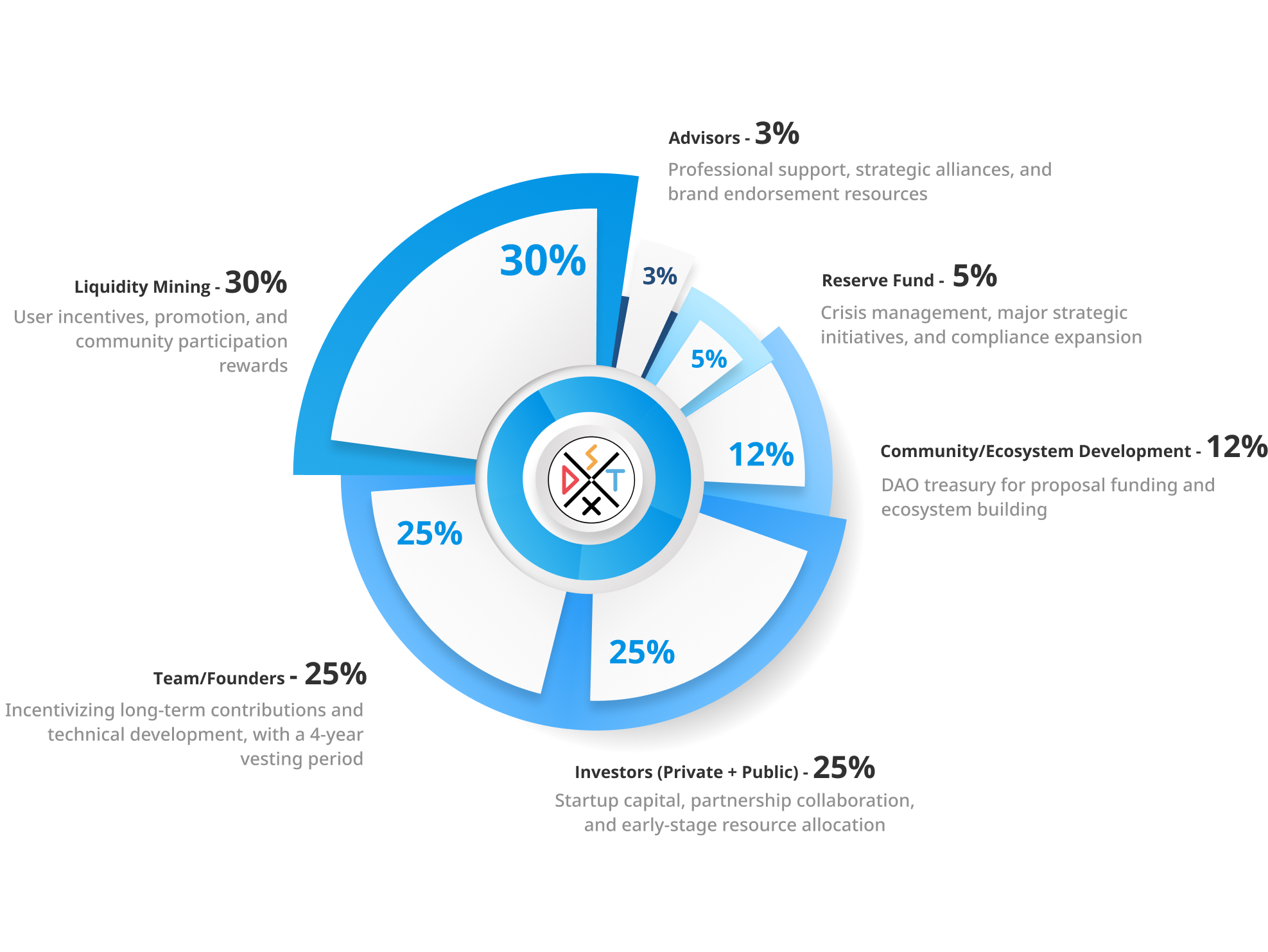
Allocated tokens do not arrive at once. Each allocation has a cliff — a period at the start during which nothing at all unlocks — followed by a linear release period, over which the remainder unlocks gradually rather than in a single tranche. A 12-month cliff with a 36-month linear release means nothing for the first year, then a steady release across the three years that follow.
The purpose is to keep the people who built the project holding it long enough to be affected by how it turns out.
| Category | Cliff | Linear Release Period | Unlocking Method and Governance Restrictions |
|---|---|---|---|
| Team / Founders | 12 months | 36 months | 4 years total, no voting rights for locked tokens |
| Private Investors | 12–18 months | 12–18 months | Unlocked in rounds, progress announced periodically |
| Advisors | 6 months | 12–18 months | Tied to task contributions and advisor contract terms |
| Community / DAO | None | DAO determined release | Controlled by multi-signature + community governance voting |
| Category | Total Share | Release Plan | Unlocking Method and Governance Restrictions |
|---|---|---|---|
| Public Offering (IDO) | 0–20% TGE | Remaining proportion (80–100%) linear release within 3-6 months | Can set instant release cap + dynamic announcements |
| Reserve Fund | Activated as needed | Activated as needed | Used for rapid response and repair funds in case of protocol security vulnerabilities, market shocks, or critical infrastructure failures. |
Note: TGE (Token Generation Event) refers to the time point when tokens are first generated and can be distributed, typically the beginning of the project's official token issuance phase. TGE is not equivalent to exchange listing but often occurs close to or concurrently with it.
Adopts the veDST staking model:
Players earn Contracts, not DST. Contracts are funded by advertising revenue, as set out in the revenue chapter.
Contracts may be redeemed for DST. That DST comes from the ecosystem reward pool — the 30% allocation, 1,800,000,000 DST. The pool is the ceiling on everything DxSxT can ever pay out as rewards anywhere in the ecosystem. It is not an emission schedule: nothing is released on a calendar, and there is no halving mechanism. DST leaves the pool only when a product in the ecosystem pays a reward out of it.
The games are the pool's first draw, not its only one.
| What draws on the pool | What the reward is for | Status |
|---|---|---|
| DxSxT's own games | Players redeem Contracts they earned by playing | Live |
| Third-party GameFi titles | Rewards inside games built on the DxSxT SDK | Planned |
| Creator platform | Rewards for creators and for the audience they bring | Planned |
Two limits govern rewards, and they constrain different things. Reading them as one is the easiest way to misunderstand the model.
The token limit. 1,800,000,000 DST is all there will ever be for rewards. Once the pool is spent, no more DST is created to refill it — doing so would be a change to the supply model, which the section above places under DAO governance.
The business limit. In any given period, DxSxT hands out only as many Contracts as that period's advertising revenue pays for. Earn more from advertisers and more Contracts can be issued; earn less and fewer are. Contracts are never issued against revenue that has not arrived.
The second limit is the one that does the work day to day. The pool sets how much can ever be paid out; advertising revenue sets how fast it is paid out. Token release cannot run ahead of the business.
The pool is not replenished. DxSxT does not purchase DST to refill it. DST that DxSxT buys back is burned; it does not return to the pool.
The conversion rate from Contracts to DST, the redemption minimum and fees, and how the pool is divided between the three products above will be published separately.
Earning Contracts requires no purchase and no deposit. Redemption converts a reward already earned; it is not a subscription, an investment, or a return on capital.
DxSxT Network is not just a set of protocols and a token mechanism; it is an open and extensible on-chain value network. Through the design of the DST Token and its modular protocol architecture, various roles such as creators, players, protocol developers, and contributors can participate, forming a tangible flow of value.
The scenarios below describe how the token is designed to move between participants. Apart from players earning rewards, none of them is in operation today; the module status table in the architecture chapter states which components are live.
| Participant | Action | DST Value Flow | Corresponding Module |
|---|---|---|---|
| Players | Play games; Quests and rewarded video yield accelerators | Play produces Contracts, redeemable for DST from the redemption reserve | Reward Distribution Module |
| Game Developers | Deploy game protocols | Require staking DST to use game modules and tools | Protocol Integration Module |
| Guilds / Referrers | Refer users to participate | Earn DST based on the activity of referred users | Referral Incentive Module (not yet active) |
DxSxT will provide a GameFi SDK, enabling third-party developers to quickly integrate DST-driven reward and governance modules.
| Participant | Action | DST Value Flow | Corresponding Module |
|---|---|---|---|
| Creators | Publish creative content | Can receive DST as support and transaction returns | On-chain Transaction Engine / NFT Module |
| Supporters | Tip / purchase creative content | Pay DST to support creators | Ecosystem Payment Module |
| Content Platform Providers | Integrate creator protocols | Require staking DST to qualify for module usage | Protocol Integration Module |
DxSxT supports "content as an asset," allowing creators to put their works on-chain and customize NFT sales and licensing rules.
DAO governance is not operating. This chapter states who decides today, describes the governance model that has been designed, and explains how protocol upgrades are executed in the meantime.
All decisions that the designed model would place with the DAO currently rest with the operator. That includes treasury allocation, community release schedules, the rate at which Contracts redeem for DST, any change to the supply model, contract upgrades, and which modules are integrated.
There is no community vote at present, and no proposal may currently be submitted on-chain. The transfer of these powers is a future event, not a present condition.
Protocol changes on DxSxT do not require a chain fork. The contracts are Solana programs, and a program is changed by deploying a new version under the control of an upgrade authority; the chain itself is unaffected, and no user action is required.
This makes the upgrade authority the most consequential control in the system. Whoever holds it can replace the running code, and with it the rules that govern balances, rewards and lock-ups. It is held as follows:
| Control | What it allows | Who holds it today | Designed position |
|---|---|---|---|
| Upgrade authority | Replacing the running contract code | The operator, and only with several key-holders signing | The DAO, executing an approved proposal |
| Timelock before execution | A waiting period between approval and execution, during which the change is visible and can be reversed | The operator | A fixed delay, published in advance |
| Emergency pause | Halting contract operations without waiting for a vote | The operator | The operator, with the DAO reviewing the decision afterwards |
The ability to upgrade without a fork is both a convenience and a risk for users: the rules can change without their participation. This document therefore states who holds that authority today before describing the voting model that is not yet in force.
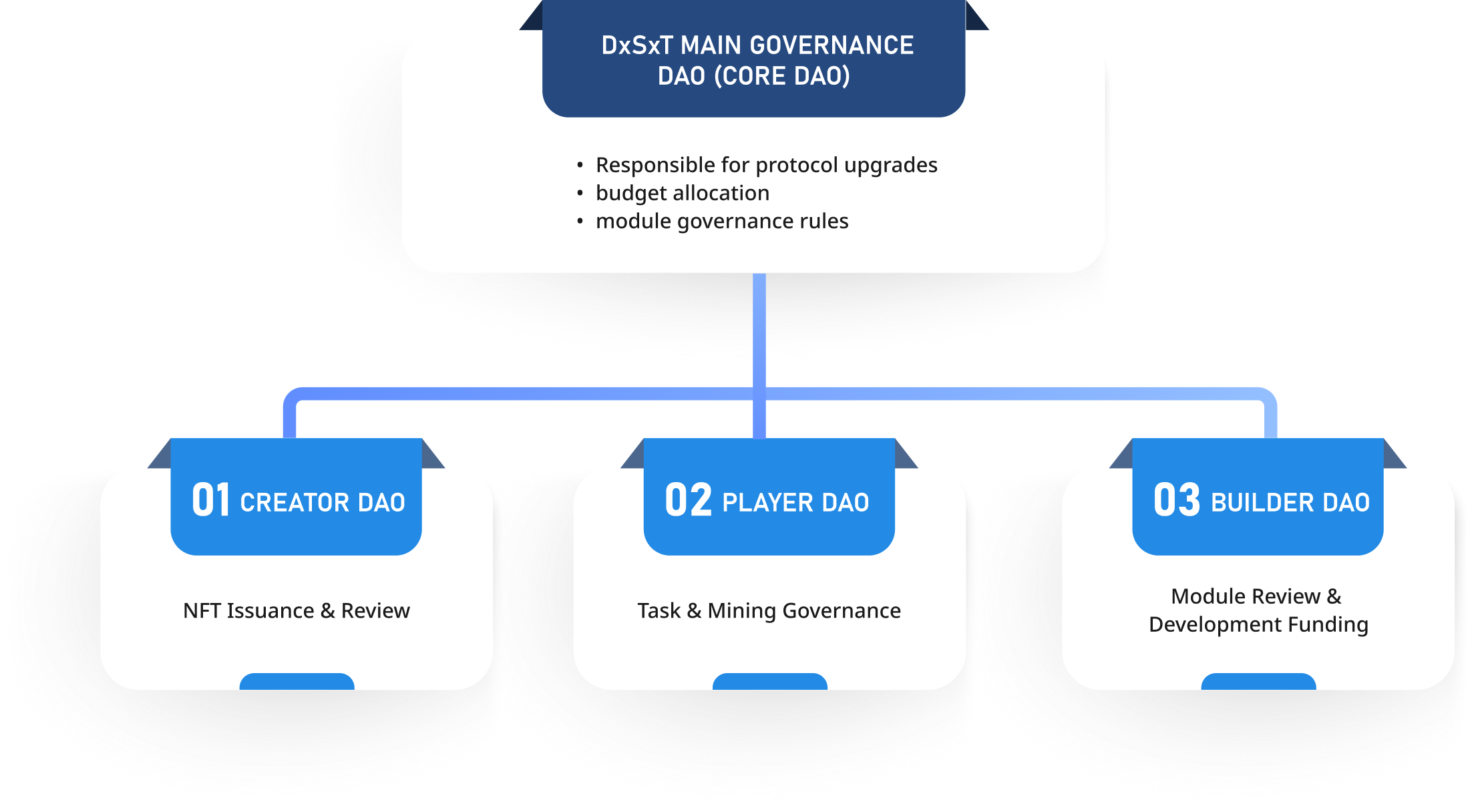
Everything in this section is design. None of it is in operation.
Principles
veDST weight
Voting weight is not the number of tokens held. It is the number of tokens locked, multiplied by a coefficient set by how long they are locked for. Locking the same amount for longer produces more weight: 1,000 DST locked for 24 months carries six times the weight of 1,000 DST locked for one month.
The effect is that influence is bought with time rather than with size, and anyone voting on a decision is still holding tokens when its consequences arrive.
| Lock-up period | Weight per 1,000 DST locked | What the holder may propose | Cap on a single address |
|---|---|---|---|
| 1 month | 250 | Nothing; may vote only | 2% of total weight |
| 3 months | 500 | Proposals limited in scope | 3% |
| 12 months | 1,000 | Proposals affecting the whole protocol | 4% |
| 24 months | 1,500 | Requests to spend from the treasury | 5% |
Two design decisions are worth stating explicitly. Governance participation earns no reward, so there is no incentive to vote purely to farm returns. And the cap applies to weight rather than to holdings, so accumulating tokens beyond the cap confers no additional control through this mechanism.
Proposal process
| Phase | Action |
|---|---|
| 1. Draft | Proposal published for discussion, stating objective, budget and expected impact |
| 2. Review | Filtering of duplicate and spam proposals before an on-chain vote is opened |
| 3. Vote | Proposal goes on-chain; passes on reaching both turnout and approval thresholds |
| 4. Delay | Approved proposals wait out a timelock before execution |
| 5. Execution and tracking | Execution recorded on-chain; a proposal may be amended or reversed by a subsequent vote |
The review stage in phase 2 is a filter held by a review body, not an automatic process.
The turnout threshold, the approval ratio, the minimum weight to submit a proposal, and the length of the timelock will be published before DAO governance is activated.
Treasury
| Item | Position |
|---|---|
| Sources | Unallocated DST, reclaimed allocations, and protocol fees once fee-bearing modules are active. Operating revenue from advertising is described in the revenue chapter and is not treasury income. |
| Uses | Ecosystem grants, developer subsidies, events, liquidity provision |
| Control | Multi-signature execution; DAO approval once governance is active, operator approval until then |
| Reporting | Prepared by the operator; published by the DAO once governance is active |
Tooling
The on-chain governance program is SPL Governance, the Solana standard for proposals and weighted voting. Front-end and discussion platforms will be selected at the time governance is launched; this document does not name vendors in advance.
We do not list further governance features — sub-DAOs, reputation systems, cross-organisation alliances — while the first vote has not yet been held. Those belong in a document written after governance is running, not before it has started.
Security in DxSxT has three separate parts, and they fail in different ways.
The contracts can be attacked directly. The reward system can be farmed by users who never intended to play. And user data can be over-collected or mishandled. Documents of this kind usually cover only the first. For a product that pays people for their attention, the second is where the practical risk sits, and the third is where the regulatory risk sits.
| Control | Design | Status |
|---|---|---|
| Upgrade control | Upgrades execute through a timelock with multi-signature approval | Active; authority held by the operator |
| Emergency pause | Pause permissions restricted to multi-signature addresses | Planned |
| Re-entrancy protection | Program structure and state locking in the Solana program | Active |
| Arithmetic overflow | Rust checked arithmetic on all value operations | Active |
| Privilege separation | Administrator and user permissions separated; least privilege | Active |
| Event logging | Critical operations emit on-chain events for tracing | Active |
| Independent review | Third-party security review of the contracts, report published | Planned |
On the last row: contracts are to be reviewed by an independent third-party security firm, and the report published. This section will name the firm, the date and the scope of the review, and link the report, once one is complete.
Any system that pays users for actions will be attacked by people automating those actions. This is the most likely attack on DxSxT, and it is an economic attack rather than a technical one: it does not break anything, it simply drains the reward budget and degrades the quality of the traffic sold to advertisers.
The forms it takes:
| Attack | Effect |
|---|---|
| Multi-accounting | One person operating many accounts to multiply rewards |
| Idle farming | A session left open on an unattended device, or many emulator instances, accruing progress without play |
| Emulators and automation | Scripted play and scripted Quest completion without a real user |
| Ad fraud | Fabricated ad impressions or completions, which advertisers claw back |
| Referral farming | Self-referral rings that generate rewards without new users |
| Reward arbitrage | Extracting rewards at a rate the advertising revenue cannot fund |
Two structural defences are worth stating, because they are design decisions rather than detection rules:
We do not publish detection thresholds, device-signal logic or scoring rules. Once published, they would no longer work.
| Area | Measure |
|---|---|
| Wallet | Connection only through the Solana Wallet Adapter standard; fixed signature message templates; source domain binding |
| Signing | Expiry times on signature requests, phishing-contract flagging, risk prompts on unusual requests |
| Administrative access | Role-based access control and multi-party approval on privileged operations |
| Keys | Non-custodial; multi-signature and whitelisted addresses for operator-held keys |
The SDK described in the developer chapter has not been released. Statements about SDK security belong in this document once it exists.
Governance is not active, so the governance attack surface is currently the operator's own controls, described in the governance chapter. The designed protections — a minimum weight to submit a proposal, a cap on single-address weight, a voting delay and a timelock before execution — take effect only when governance launches.
The authoritative statement of what DxSxT collects is the published Privacy Policy, not this document. This chapter does not restate it, and where the two differ the Privacy Policy governs.
Risk disclosure, jurisdictional restrictions and the limits of this document are set out in the Legal and Risk Disclaimer chapter. Three positions belong here:
| Area | Position |
|---|---|
| Token character | DST is a functional token. It does not represent equity, a yield entitlement, or an investment commitment. |
| KYC and AML | Identity verification at redemption is carried out independently by a regulated third-party verification provider. The jurisdictions in scope and the applicable thresholds follow local law. |
| Jurisdictions | Promotion and participation are restricted in jurisdictions that prohibit or restrict crypto assets. See the Legal and Risk Disclaimer chapter. |
How DxSxT recognises the different ways people contribute, and which of those mechanisms are operating today.
The commercial model — where the money comes from and how it is shared — is set out in the revenue chapter and is not repeated here.
| Role | What they do | What they receive | Status |
|---|---|---|---|
| Players | Play the games, complete Quests, refer others | Contracts, funded by advertising revenue | Live |
| Stakers | Lock DST for a fixed period | Governance weight under the veDST model | Not yet active |
| Developers | Build modules and integrations on the protocol | Grants from the DAO treasury | Not available; the SDK has not been released |
| Contributors | Translation, documentation, community operations | Grants from the DAO treasury | Not available; DAO governance not yet active |
Only the first row is in operation. The rest describe roles the protocol is designed to support once the corresponding modules are active.
DxSxT does not operate a node network, and no role in this ecosystem involves contributing hardware, bandwidth, storage or compute.
DST locked for a fixed period produces veDST, which determines governance weight. The lock-up periods, coefficients and limits are set out in the governance chapter and are not repeated here.
Beyond voting, veDST is designed to influence priority of access to protocol modules and weighting in periodic distributions. veDST is non-transferable during the lock-up period.
The staking module is not yet active.
The DAO treasury is intended to reserve a share of DST for grants to those building on the protocol, in three categories:
Until DAO governance is active, allocation decisions rest with the operator, as set out in the governance chapter. No grant programme is currently open for applications.
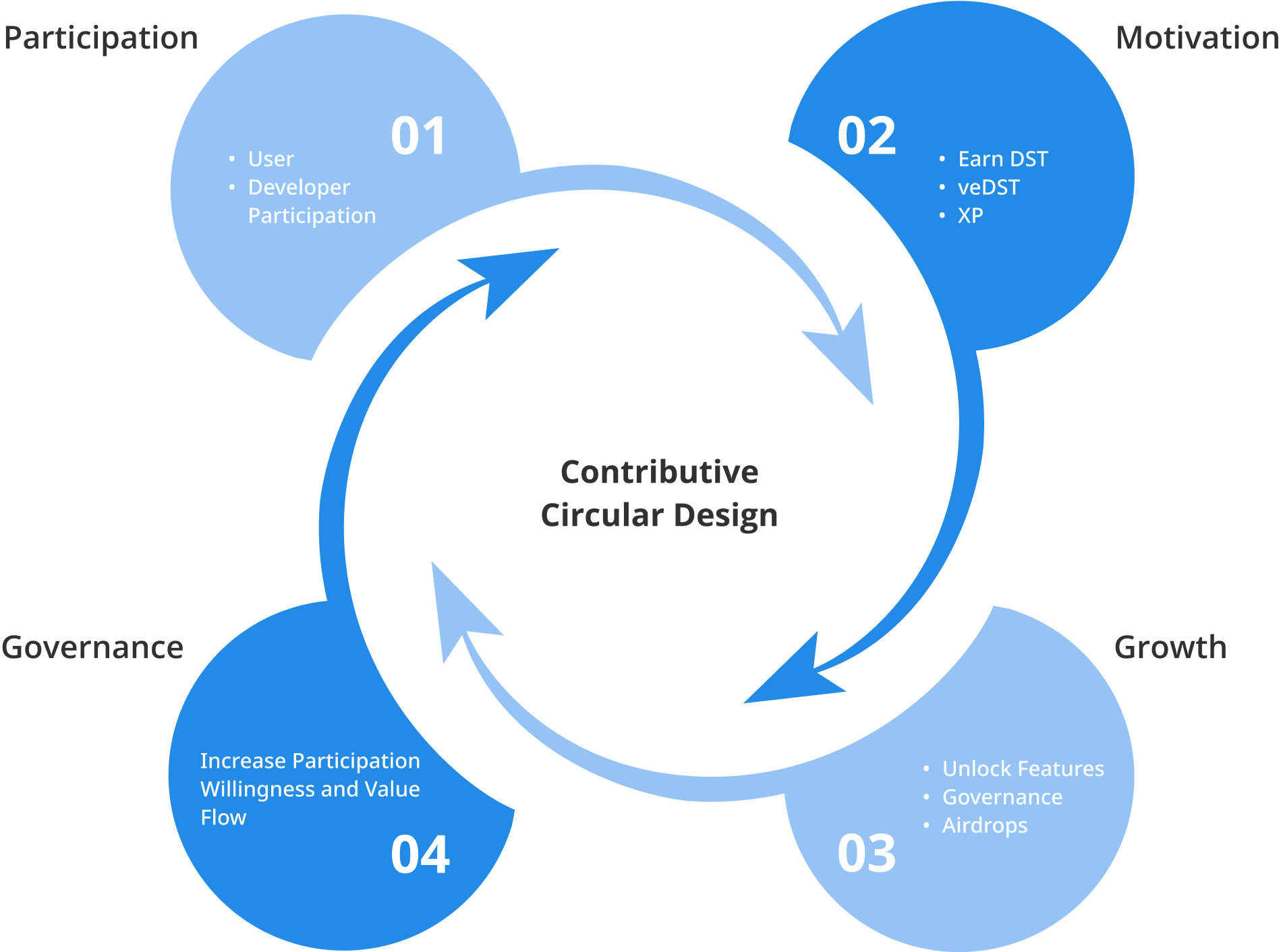
This roadmap states what is running, what is being built next, and what is a direction rather than a plan. It does not attach dates to items that do not yet exist.
An item moves from one column to the next only when it is live; the module status table in the architecture chapter is updated at the same time.
| Item | Detail |
|---|---|
| Games | The DxSxT game portfolio, playable without any account linkage or task completion |
| Contracts | Earned through play, funded by advertising revenue |
| Rewarded video | Served through Google AdMob |
| Quests | Advertiser tasks supplied through Unity LevelPlay offerwall inventory |
| On-chain | DST token contract, reward distribution, and NFT issuance through the transaction engine, all deployed on Solana |
Work on the items below is under way in parallel. They are listed without a fixed order, and no dates are attached until an item is live.
| Item | What it requires |
|---|---|
| Mobile application | In development for iOS and Android in parallel; neither platform is sequenced ahead of the other |
| Creator platform | An audience large enough that creators have a reason to publish into it |
| Developer tooling — GameFi SDK | Published module interfaces and a supported integration path (see the contracts chapter) |
| Staking — veDST | The staking module activated; parameters as set out in the tokenomics chapter |
| DAO governance | Governance thresholds decided and the governance module activated |
| Interoperability with other chains | Mature third-party bridging; no target chains are named in advance |
A DxSxT chain of our own. The Solana deployment is a starting point rather than a destination. This is a direction with no timeline attached: operating a chain is a far larger undertaking than operating an application, and it is only justified if the games, the reward economy and the ecosystem reach a scale that requires it.
Items marked Next are in progress; items marked Later are stated directions. Both may change, be re-sequenced, or be dropped.
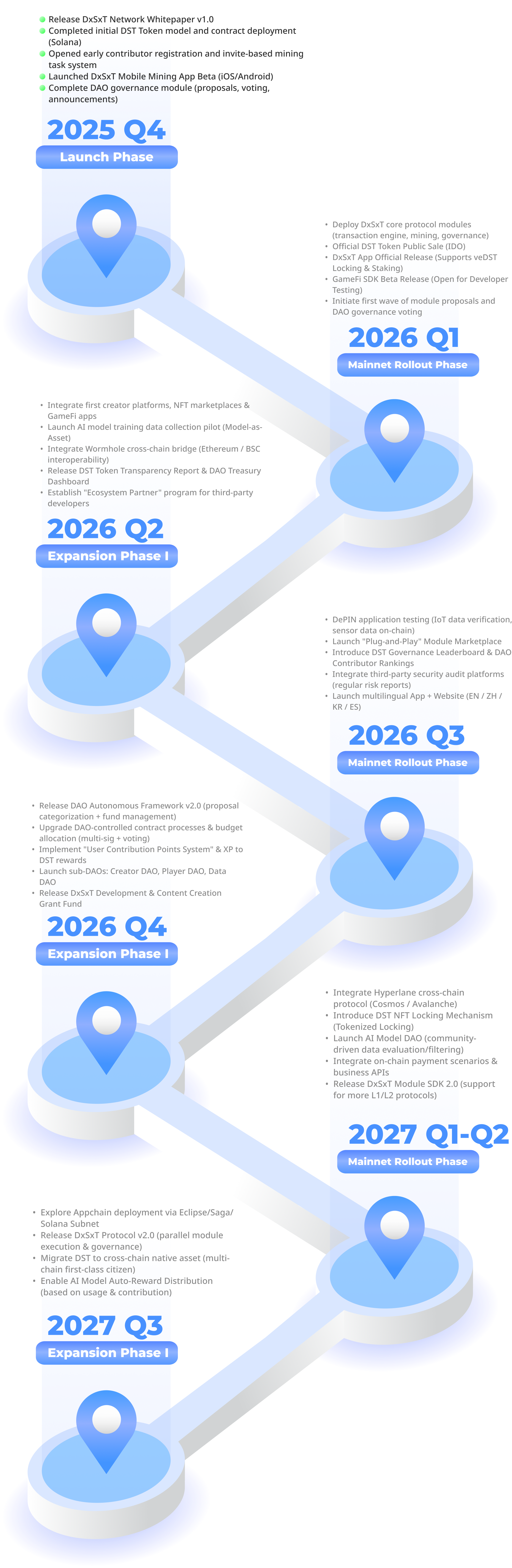
Notice
Official product updates, community news and announcements from DxSxT Network.